
Why Standard Work Isn’t Just for the Floor: Bringing Consistency to Admin Processes

Most leaders obsess over standard work on the shop floor, yet overlook the part of the business where inconsistency quietly drains time, money, and energy. The administrative side of your company has as much impact on throughput and customer satisfaction as production does, but it is often the least documented and least standardized. I recently worked with an admin team that struggled with errors and rework, and a simple implementation of standard work cut rework by 60 percent. The transformation was immediate and lasting, and it changed how the entire company viewed consistency. When most people hear the term standard work, they think of machines, operators, and production lines. But the truth is that your administrative processes, daily decisions, and back office workflows often determine whether your customers experience smooth delivery or constant friction. Admin work is full of invisible handoffs, individual interpretations, and tribal knowledge. One person enters data one way, another uses a slightly different method, and a third has a workaround that only they understand. These inconsistencies compound over time and show up as delayed invoices, missed customer commitments, incorrect orders, or confusion between teams. Even worse, administrators often operate in environments where expectations are implied rather than documented. Without clear agreement on how tasks should be completed, everything depends on the habits and judgment of individuals. That is not scalable and certainly not predictable. Standard work brings the same clarity, consistency, and confidence to admin processes that Lean practitioners have relied on in manufacturing for decades. Not long ago, I worked with an administrative team that felt constantly overwhelmed. Although they were talented and hardworking, they were dealing with a surprising amount of rework. Tasks had to be redone again and again because each team member had their own method of completing the same workflow. Customer orders were entered inconsistently. Project files were named differently depending on who created them. Emails to suppliers varied in content and tone. Reporting deadlines slipped because no one had the same understanding of what “complete” looked like. The team estimated they spent nearly half their time fixing avoidable mistakes. When we mapped out their workflows, the root cause was clear. There was no standard method for any of their core processes. Once we implemented standard work, the results were dramatic. Rework dropped by 60 percent almost immediately. The team finally had a shared language and a shared process to follow. What had been chaos turned into predictable flow. Standard work for admin functions does not mean rigid scripts or micromanagement. It means removing ambiguity so that people can do their best work without friction. Here are a few examples of what standard work can include: 1. Standardized Templates and Tools• Email templates for recurring communication• Standard file naming conventions• Documented checklists for recurring tasks such as order entry or onboarding• Guided workflows built into software systems These reduce variation and speed up completion time. 2. Clear Definitions of “Done”Admin teams often suffer because “done” means different things to different people. Standard work clarifies expectations with documented criteria. 3. Visual ReferencesQuick guides, screenshots, or simple flowcharts can eliminate guesswork, especially during cross training or onboarding. 4. Standard Cadence and TriggersWhen should reports be run? What triggers a follow up email? What is the expected turnaround time for entering orders? Standard work defines the rhythm of work to prevent last minute scrambles. When standard work is introduced outside the shop floor, companies are often surprised at the broader impact: Consistency Improves Customer ExperienceWhen admin processes are reliable, communication is timely, orders are accurate, and teams can trust each other. Morale Improves Because Uncertainty DisappearsTeams feel more confident and less stressed when they are not constantly guessing or second-guessing. Cross Training Becomes EasierA documented process allows anyone to step in quickly when someone is out, preventing delays. Leadership Gains VisibilityStandard work highlights bottlenecks, workload issues, and improvement opportunities that previously hid behind informal habits. Continuous Improvement Becomes PossibleYou cannot improve what everyone does differently. Standard work gives you a solid foundation for kaizen and ongoing optimization. If you want to bring standard work to your administrative teams, start simple. Over designing slows progress. Instead, focus on clarity and usability. Step 1: Observe the WorkWatch how the team completes a task. Ask questions. Look for differences in approach. Step 2: Map the ProcessIdentify the steps that actually matter and remove unnecessary variation. Step 3: Create an Easy-to-Use StandardA one page checklist beats a 20 page document no one reads. Step 4: Socialize and TrainMake sure everyone understands the new standard and why it exists. Step 5: Review and ImproveStandard work is a living document. Revisit it periodically and keep improving. When companies implement standard work in administrative roles, they often discover something profound. Predictability is not just a production advantage. It is a competitive advantage. Customers feel the difference. Employees feel the difference. Leadership feels the difference. Standard work brings order to the unseen side of the business and creates stability that supports growth. Schedule a Free Consultation
Fixing the Flow: Value Stream Mapping in Manufacturing and Distribution

If you have ever felt like your team is constantly working yet never actually gaining ground, you are not alone. Many manufacturing and distribution companies suffer from a silent killer: hidden inefficiencies buried inside daily processes. One of the fastest ways to expose those gaps is through value stream mapping. The moment you visually lay out every step from order to delivery, the truth becomes impossible to ignore. In a recent project, a simple mapping exercise revealed that a client had nearly 40 percent non value add time, and to make matters worse, the wrong people were doing the work. What looked like a resource problem was actually a flow problem. Once you see it, you cannot unsee it. Value stream mapping (VSM) is one of the most powerful tools in Lean because it does not guess at the sources of waste. It shows them. It highlights the waiting, the rework, the duplication, and the handoffs that drag down productivity and frustrate employees. When done correctly, VSM becomes the turning point that shifts a company from reactive firefighting to intentional operational excellence. Why Flow Breaks Down in Growing Organizations As companies scale, especially in engineering heavy or high mix environments, complexity creeps in. New products, new services, new customer demands, and new team members all create changes in how work gets done. The issue is that processes rarely evolve with that growth. People simply work harder, stretch further, or hand tasks off informally because it is “just faster this way.” That is exactly what I uncovered during a value stream mapping event at an engineering firm. Leaders believed they were short staffed. They assumed bottlenecks were the result of employees being too slow or lacking capacity. But once we laid out the actual workflow on the wall, step by step, it became immediately clear that the work was not flowing poorly because of the people. The work was flowing poorly because the process was broken. Forty percent of the time in the stream was non value add. People were waiting for information, passing tasks to the wrong departments, or getting pulled into work that did not match their role or skill set. The wrong people were doing the job, which caused rework, delays, and frustration across the entire organization. The Power of Seeing the Whole System One of the biggest advantages of value stream mapping is that it shows the full system, not just isolated pain points. You can finally see how decisions made in engineering affect purchasing, or how delays in approvals impact manufacturing, or how unclear handoffs slow down shipping. In the engineering firm I worked with, each department believed they were doing their part efficiently. And they were, from where they stood. But when we pulled the entire team into one room and mapped the end to end flow, they were stunned by how disjointed the process had become. Handoffs were not clear. Priorities shifted mid stream. Tasks were piling up on people simply because they were the ones who always said yes, not because the tasks belonged to them. Seeing everything visually shifted the conversation from “Who is messing up?” to “How did the process get this complicated?” That mindset shift is when real improvement starts. Fixing the Flow: What Changed Once the team saw the waste, they were fully bought in. We redesigned the value stream together, assigning the right work to the right people and removing unnecessary steps. We rebalanced responsibilities and aligned tasks with skill sets. We clarified handoffs and established clear communication points so that no one had to guess who was doing what or when. The results were immediate. Cycle time dropped. Bottlenecks disappeared. Employees felt relief because they were finally working on the tasks they were qualified for instead of being pulled in every direction. Leaders gained clarity because the process was not a black box anymore. It was visible, understood, and controlled. This is the power of value stream mapping. It restores flow. How to Know Your Organization Needs Flow Mapping If you answer yes to any of these questions, VSM will transform your operations: Do you struggle to meet deadlines even when your team is working hard? Do you have constant rework, confusion, or handoffs that fall between the cracks? Do your people wear too many hats or step outside their roles to get work done? Are you feeling pressure to hire because the workload seems overwhelming? Do you suspect workflow issues but cannot see exactly where things break down? Value stream mapping removes the guesswork. It gives you the blueprint to make informed decisions that reduce waste and increase speed without burning out your team. Flow Mapping Is Not a One Time Fix Value stream mapping is not something you do once and forget. It is a strategic tool that should be revisited as your company grows, adds new products, or shifts direction. Every time you do it, you gain sharper insights. You see new opportunities. You uncover new efficiencies. Companies that make flow mapping part of their culture consistently outperform those that rely on gut feel or isolated improvements. When your operations flow smoothly, everything else becomes easier. Customer satisfaction rises. Lead times shrink. Teams collaborate instead of collide. And most importantly, leaders can focus on strategic growth instead of putting out fires. Schedule a Free Consultation
AI + Lean: Using Artificial Intelligence to Find Bottlenecks Faster

If you could see every delay, misstep, and hidden slowdown inside your process in real time, how fast could your business improve? Most companies rely on tribal knowledge or end of month reports to discover operational problems, but by then the damage is already done. The real opportunity is using AI to pinpoint bottlenecks as they happen, allowing Lean principles to do what they do best: remove waste, speed up flow, and increase profit. In one operation I worked with, simply using AI to highlight delays in material movement reduced cycle time by 12 percent. Here is how AI and Lean work together and what it means for your business. AI and Lean Are Not Opposites. They Are Accelerators. For years, Lean practitioners have said that the best way to understand a process is to walk it, observe it, and map it. That is still true. Lean is built on real-world observation. But today, AI gives us the ability to observe more, see more, and find patterns humans would never be able to detect in time. Lean identifies the waste.AI helps you find it faster. Most companies do not fail because they lack data. They fail because the data arrives too late or is too overwhelming to interpret. AI solves this problem by watching what is actually happening in the process and flagging abnormalities the moment they occur. That is exactly what happened in the case study below. The Case Study: A 12 Percent Cycle Time Reduction Powered by AI A mid-sized operation experienced inconsistent output and unpredictable cycle times. Leadership believed the issue was staffing, equipment, or even operator discipline. Instead of guessing, we used AI to analyze real-time material movement across the floor. The AI identified something surprising.The delays were not happening at the workstations.They were happening between them. Material sat idle longer than anyone realized, and the movement patterns were inefficient. Workers compensated the best they could, but the system itself made flow slower than necessary. Once we knew the truth, Lean problem solving took over: We remapped the material flow. We redesigned staging points and travel paths. We balanced workloads based on real cycle time data rather than assumptions. The result was clear.Cycle time dropped by 12 percent with no new equipment and no extra labor. The AI did not replace Lean.It enabled Lean to work faster and more accurately. How AI Supercharges Lean Improvement Here are the biggest ways AI enhances traditional Lean tools. 1. Faster Bottleneck Identification Finding the true bottleneck is often the hardest part of improvement work. AI solves that by: Tracking movement automatically Flagging delays as they occur Highlighting time lost between steps Showing where work piles up Instead of guessing or relying on one-time observations, you see actual patterns across thousands of cycles. 2. Real-Time Visibility Instead of End-of-Month Surprises Lean thrives on immediate feedback loops. AI gives you: Live dashboards Alerts for abnormal delays Predictive patterns that show future slowdowns This kind of visibility keeps teams focused on what matters without drowning in data. 3. Confident Decision-Making Based on Facts, Not Feelings One of the biggest struggles in improvement work is overcoming subjective opinions.AI provides neutral ground.Lean provides the method. Together they create alignment around the truth of what is happening. 4. Eliminating Waste Before It Becomes Expensive When AI highlights inefficiencies early, you can: Fix small problems before they snowball Reassign people based on real workload Avoid unnecessary capital spending Improve customer experience Waste does not have time to grow roots. What AI Cannot Do AI cannot fix culture.AI cannot redesign a process on its own.AI cannot hold people accountable or teach them to follow standards. That is where Lean thinking remains unmatched. Lean builds clarity, discipline, and ownership.AI provides detection and insight. The combination is powerful because each fills the other’s gaps. Where Most Companies Get Stuck Even large operations tend to fall into one of these traps: They collect tons of data but never use it. They chase automation before understanding their process. They treat AI as a magic wand instead of a tool. They try to fix symptoms instead of causes. The key is sequencing.Before you improve a process, you must see it clearly.AI makes that visibility sharper and faster. How You Can Start Using AI + Lean Today You do not need a massive budget or a full transformation. Start simple. 1. Pick one process and ask one question Where does work stall?Even without AI, this shifts attention to flow. 2. Use small AI tools, not giant platforms There are inexpensive apps that track material movement, employee load, or machine downtime with minimal setup. 3. Pair AI insights with Lean practices Process mapping Root cause analysis Standard work Flow redesign AI shows the problem.Lean fixes it. 4. Measure the impact immediately Cycle time, throughput, and work-in-process levels will show improvement fast when the combination is done right. AI + Lean Is the Future of Operational Excellence The businesses that thrive over the next decade will not be the ones with the most data or the most automation. They will be the ones who understand their processes deeply and use AI to enhance that understanding. If you have ever wished you could see the bottlenecks the moment they happen, reduce cycle time without spending money, or make improvement decisions based entirely on facts, then AI and Lean together can give you exactly that. And as the case study showed, even small insights can create big results. A 12 percent cycle time reduction is not a miracle. It is what happens when visibility meets disciplined improvement. Schedule a Complimentary Call
Before You Automate: Map the Process First
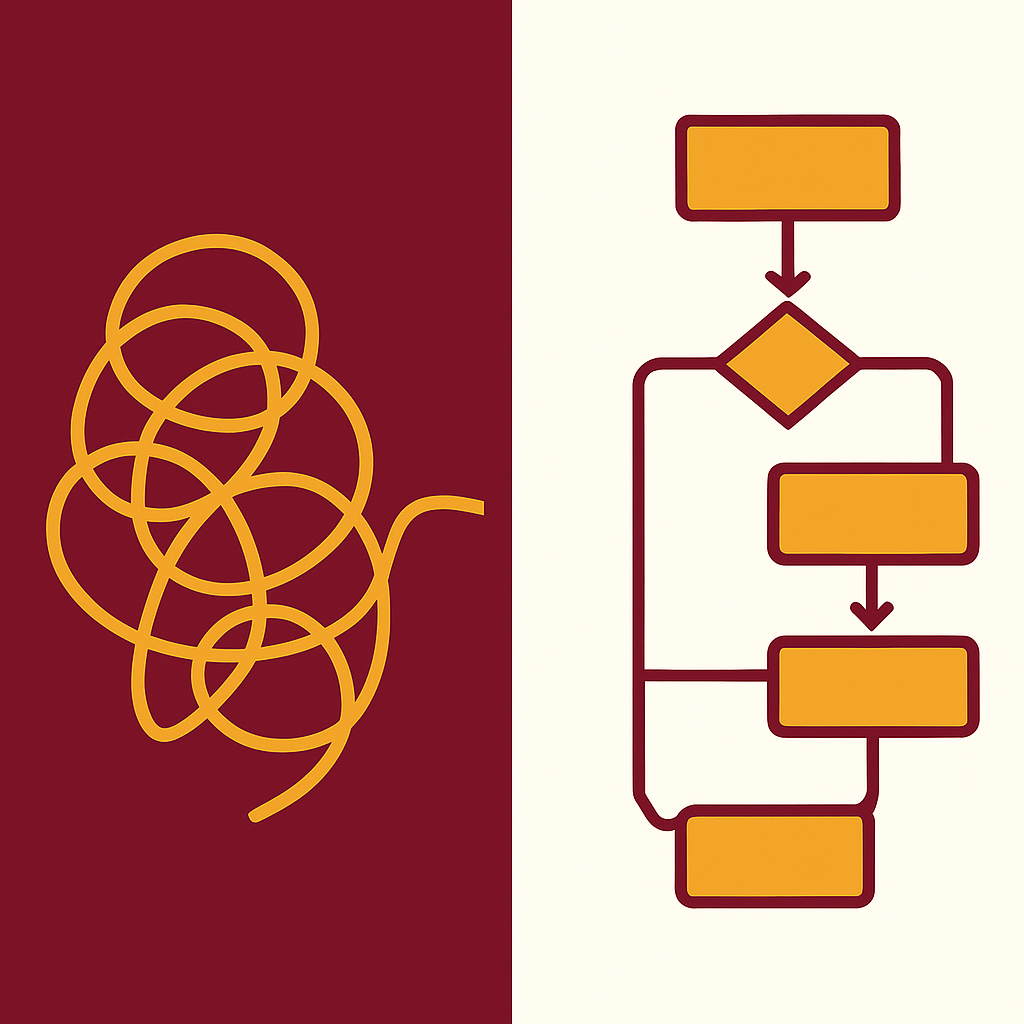
If your business is constantly putting out fires, automation will not save you. In fact, it may accelerate the chaos. Before you add software, AI, or automations to smooth out the work, you need something far more fundamental: a clear, accurate map of how the process actually works today. I saw this firsthand with a pool service company losing customers and cash simply because no one understood the true flow of their service process. What happened next changed everything. Before You Automate: Map the Process First Automation promises efficiency, speed, and consistency, but only when it is built on stable ground. Too often, companies rush to automate broken processes. They add software to compensate for confusion, introduce tools without clarity, and hope technology will magically solve operational challenges. What they discover is the opposite. Automation amplifies whatever exists, good or bad. This is why process mapping is not a nice-to-have step. It is the foundation. And nothing illustrates that more clearly than a recent engagement I had with a pool service company struggling with service failures, late jobs, inconsistent communication, and slow collections. The Real Problem Wasn’t Labor or Software, It Was Invisible Work When I first met the owners, they believed they had a people problem. Technicians were missing steps. Office staff were overwhelmed. Customers were frustrated. And revenue was slipping through the cracks. The instinct was to buy a new software tool that could automate scheduling, reminders, and billing so the business could stay on track. But after listening carefully, it became clear that automation was not the cure. The real problem was that no one truly understood the flow of work. Everyone handled tasks differently. Information was scattered across texts, emails, handwritten notes, and memories. There was no standard process to automate. So we paused the software search and held a mini kaizen event instead. The Power of Mapping What Is Really Happening A kaizen event, even a short one, forces the team to slow down and see the truth. We brought together everyone involved in serving a customer: the office manager, technicians, scheduler, and the person responsible for collecting payments. Together, we mapped out the entire customer journey from the first phone call to final payment. Post-it notes filled the wall. At first it looked chaotic, but clarity slowly emerged. Here is what we discovered: 1. No one had the same understanding of the process.The office believed technicians were documenting findings at the job site. Technicians believed the office already had the information and did not need it repeated. This created gaps that customers felt immediately. 2. Parts were constantly delayed because ordering relied on memory.By the time someone realized a part was needed, the job was already behind schedule. Customers waited, work stalled, and the company looked unreliable. 3. Collections only happened at the very end.The company asked for payment once, at the hardest point to collect. Thirty, sixty, even ninety days passed before money came in. 4. Everyone had created their own workaround.Technicians kept notes on their phone. The office kept notes in a binder. The owner kept notes in email. None of these connected. No automation tool can fix what a process map reveals. But a process map makes fixing it possible. Redesigning the Process to Reduce Failure Points Once the whole team saw the real flow of work, the solutions became obvious. We redesigned the service process step by step, removing unnecessary tasks and making responsibilities unmistakably clear. Some of the biggest improvements included: A standardized intake process.Every customer call captured the same information in the same way, ensuring technicians had what they needed before arriving on-site. A defined parts ordering system.Instead of relying on memory, we built an early identification step where techs flagged what parts were needed before leaving the job. This triggered immediate ordering and prevented delays. Multiple built-in collection points.By adding payment requests earlier and more often, cash flow increased without adding pressure to the team. A simple shared workflow visible to everyone.Once the process was mapped and streamlined, it became easy to choose the right tool to manage it. Automation was added to support the process, not to compensate for its weaknesses. Within weeks, the company saw fewer service failures, faster turnaround times, and a noticeable improvement in customer satisfaction. Most importantly, cash flow stabilized because work moved predictably. Automation Works When Your Process Works This experience is not unique. I see it constantly in manufacturing, distribution, construction, engineering, and service industries. A company buys automation technology before mapping the process, only to find that the root issues get worse. Here is the truth: Automating a broken process does not make it efficient.It makes it break faster. Process mapping serves three critical purposes before automation: 1. It exposes the real work, not assumptions.Most leaders believe they know how work is done. A map shows what is actually happening. 2. It removes waste before technology locks it in.Software tends to institutionalize whatever exists. By removing waste first, you automate only what adds value. 3. It builds clarity and accountability.Everyone sees where handoffs occur, who owns each step, and where failures are likely. Only after you have a clean, stable process does automation give you the efficiency gains you expect. If You Want Efficiency, Start With a Marker and a Wall Businesses often look for the big solution: a new platform, an automation tool, or AI. But the biggest improvements usually come from making the existing work visible. A process map turns scattered, inconsistent effort into a clear, unified system that everyone can follow. Then automation becomes a force multiplier instead of a bandage. If your operations feel chaotic or unpredictable, do not start with technology. Start with mapping. Automation is powerful, but only if you understand what you are automating. Schedule a Complimentary Call
The Hidden Cost of Inefficiency: Why Your Process Waste Is Bleeding Profit

If you walked into your business tomorrow and discovered that 10 percent of your annual revenue was leaking out of a single broken process, would you drop everything to fix it? Most owners would say yes, yet many do not realize this is already happening behind the scenes. In fact, one of my recent clients was stunned to learn that a slow, tangled internal approval workflow was silently draining millions from their top line. Not because of market conditions. Not because of pricing. But because of invisible and preventable process waste. This is the part of operational inefficiency that most businesses underestimate. Its cost is rarely obvious until someone maps it, measures it, and reveals what you have been unknowingly leaving on the table. Why Process Waste Is So Dangerous (and So Common) Process waste creeps into organizations gradually. A sticky handoff here, an unclear approval there, a legacy system that still works but requires manual workarounds. None of these feel catastrophic on their own. But together, they create friction that compounds over time. You see it in: Longer cycle times Delays in customer responsiveness Slower decision making Employee frustration Missed opportunities Lost profit Because the waste happens slowly, businesses normalize it.“That is just how we do things.”“It only takes an extra day.”“It is not that big of a deal.” Until it is. A Real Example: When Approvals Cost a Company 10 Percent of Revenue Let us talk about that client. On the surface, their operations looked functional. Sales were steady, customers were loyal, and the team felt busy in all the usual ways. But something did not add up. Their revenue was not growing in proportion to demand. Projects stalled. Approvals bottlenecked. Employees spent their days chasing signatures, clarification, and decisions that never seemed to move. So we mapped their process end to end. What we found was eye opening. A routine approval should have taken one to two days. Instead, it averaged nine. At each stage, a task waited. It waited on managers, on email threads, on missing information, or on someone simply being unavailable. Nobody owned the workflow. No one monitored the queue. And no one realized how much time was slipping away until we showed them the full picture. Once we quantified the waste, the owner finally saw it clearly: Those delays equaled 10 percent of annual revenue lost to slow cycles, missed billing opportunities, and preventable churn. Not because the team was not working hard. But because the system they were working in was broken. The Cost of Inefficiency Is Always More Than You Think Leadership initially believed this was a small issue. A few slow approvals did not seem significant enough to affect annual revenue. But small delays ripple across the entire business. When approvals stall, billing stalls.When billing stalls, cash flow tightens.When projects wait, customers wait.When customers wait, frustration grows.When frustration grows, churn rises.When churn rises, growth stalls. This is the chain reaction most companies live with, often without realizing it. If you are not reviewing your processes with real data, you are guessing. And guesses hide waste. Efficiency Is Not a Buzzword. It Is a Profit Strategy. Operations is not just about staying organized. It is about ensuring your business delivers at the speed and quality your customers expect, without burning unnecessary time or money. Streamlining workflows is one of the highest return on investment activities any business can do because it directly affects: Revenue Costs Employee capacity Customer satisfaction Scalability In the client example above, fixing the approval process took less than 90 days. Eliminating duplicate steps, assigning clear ownership, and adding simple automation dramatically reduced the cycle time. Projects moved faster. Billing caught up. Employees shifted from chasing approvals to doing meaningful work. The result was a full recovery of lost revenue without hiring more people, raising prices, or extending work hours. How to Detect Hidden Process Waste in Your Business If you are wondering whether your business has similar leaks, start with the questions below. 1. Where do things consistently slow down?If you can name one bottleneck immediately, that is likely the tip of the iceberg. 2. Do you rely on one person for most approvals or decisions?Single points of failure create predictable slowdowns. 3. Are your teams often waiting on someone to move forward?Waiting is one of the seven classic forms of waste and one of the most expensive. 4. Do employees create workarounds to get things done?Workarounds are a sign your process is failing them. 5. Could you describe your approval or project workflow in a single paragraph?If not, it is likely too complex. The Truth Every Business Needs to Hear Most companies do not need more people. They need better systems. Most companies do not need more hustle. They need fewer inefficiencies. Most leaders do not need to work harder. They need transparency into what is slowing their business down. Process waste is quiet. But its financial impact is loud once you see it. Ready to Stop the Bleeding? If you suspect your business has hidden inefficiencies, and almost every business does, let us uncover them before they cost you another quarter of lost opportunity. I help process heavy companies streamline workflows, eliminate waste, and recover profit through practical Lean, Six Sigma, and operational excellence methods that scale, even in complex environments. If you want to know where your inefficiencies are hiding and how much they are costing you, let us talk. Schedule a Call Your revenue should not be leaking away. Let us plug the holes and put your processes back to work.
AI Pilots That Fizzle: Why Half-Adoption Creates More Chaos

If your team is dabbling with AI—trialing a tool here, spinning up a pilot there—yet nothing seems to stick, you’re not alone. Across industries, companies jump into AI with big hopes and tiny commitments: no process redesign, shaky data, light governance, and little frontline buy-in. The result? More rework, more exceptions, and more confusion than before. In this post, I break down the most common AI-adoption pitfalls, what real-world misfires teach us, and a simple path to move from “playing with models” to creating measurable business value. Why “half-adoption” backfires AI is not a feature you bolt onto a broken process; it’s a capability that depends on clean data, clear workflows, human judgment, and change management. Half-adoption happens when leaders test models without: Without those foundations, pilots “work” in demos and fail in real life—where edge cases, seasonality, and human behavior live. Lessons from high-profile AI stumbles 1) Overpromise + under-validate: IBM Watson for OncologyWatson’s early pitch suggested AI would rapidly personalize cancer treatment. In practice, hospitals found recommendations hard to trust, inconsistently validated, and poorly integrated with clinical workflows. The gap between marketing and reality eroded clinician confidence and the initiative lost momentum—an expensive reminder that rigorous validation and end-user involvement are non-negotiable in high-stakes domains. IEEE Spectrum+1 Takeaway: If the system’s recommendations aren’t transparent, validated, and embedded where decisions happen, adoption stalls. Start with narrow, auditable use cases and co-design with end users. 2) Model drift without operational guardrails: Zillow OffersZillow’s iBuying venture leaned on algorithms to price homes at scale. When market conditions shifted, the models struggled to keep pace, leading to costly mispricing and, ultimately, a shutdown of the program. Leadership publicly cited a lack of confidence in the model’s ability to predict near-term price swings—classic model-risk and drift problems compounded by operational exposure. GeekWire+2Stanford Graduate School of Business+2 Takeaway: Treat AI like any other risk-bearing system. You need monitoring for drift, stop-loss rules, scenario tests, and human override policies—especially in volatile markets. 3) Biased training data = biased outcomes: Amazon’s recruiting toolAmazon scrapped an AI hiring tool after discovering it downgraded résumés from women. The model learned from historical applications skewed toward men and reproduced that bias. Even after attempts to mask certain features, the risk of hidden proxies remained. Axios+1 Takeaway: Bias mitigation isn’t a “one and done” filter. You need representative training data, fairness testing, documented guardrails, and ongoing audit—plus a plan for how humans review borderline cases. 4) Guardrails matter: Microsoft’s Tay chatbotTay was unleashed on Twitter without adequate controls and quickly learned toxic behavior from trolls, forcing a shutdown within a day. It’s a vivid warning about deploying generative systems into uncontrolled environments without robust safety layers. TIME+2IEEE Spectrum+2 Takeaway: If the environment can shape the model (through prompts or feedback loops), invest in content filters, rate limits, red-teaming, and staged releases. The 7 pitfalls that make AI pilots fizzle A pragmatic path from pilot to value Start small, prove value, scale deliberately. Owner’s checklist (print this) Bottom line AI can absolutely pay off—but only when it’s treated as an operational change, not a tech demo. The organizations that win start with a sharp problem, fix the process, ready the data, and create durable governance. Do that, and your “pilot” becomes a repeatable engine for throughput, quality, cash flow, and capacity—without the chaos. References for further reading: IBM Watson for Oncology’s challenges in clinical adoption; Zillow’s model-risk and market-shift issues; Amazon’s biased recruiting tool; and Microsoft’s Tay guardrail failure. IEEE Spectrum+7IEEE Spectrum+7henricodolfing.com+7 Schedule a Free Consultation
Lean Thinking for Service Businesses: Eliminating Waste and Fixing Flow
Imagine needing ten people just to handle one customer service call. At this company, every step—answering the phone, ordering parts, receiving deliveries, scheduling, doing the work, and collecting payment—involved multiple handoffs and emails blasted to twenty people at a time. The result? Delays, confusion, and costs spiraling out of control. But with Lean Thinking, we transformed the process into a streamlined system managed by just three people—faster, cheaper, and far more effective. Lean Thinking in Service Businesses Originally developed in manufacturing, Lean is just as powerful in the service world because it focuses on eliminating waste and improving flow. Waste doesn’t always look like scrap materials or defective products—it often looks like wasted time, miscommunication, or duplicated effort. By applying Lean principles, this service company was able to transform a bloated process into a streamlined system that freed people’s time and improved customer satisfaction. Step 1: Mapping the Process The first step was to map out the existing workflow. Process-mapping means visually laying out each step, from the customer’s first call all the way to collecting payment. It shows who does what, where handoffs occur, and how information moves. When we mapped this company’s service process, it became clear why things were so messy. Every step required multiple approvals, constant back-and-forth emails, and manual coordination. For example, once a customer called in, the request bounced between the front office, purchasing, parts receiving, the scheduler, and finally a service technician. Each department felt responsible for “keeping everyone in the loop,” which led to dozens of emails with no clear owner. It was a textbook case of complexity breeding chaos. Step 2: Running a Kaizen Event To tackle these inefficiencies, we held a kaizen event. A kaizen is a focused, short-term workshop where employees who touch the process come together to identify problems and brainstorm solutions. The goal isn’t just to make a chart of issues—it’s to design a better way of working that everyone buys into. During this kaizen, the team identified several types of waste: Overprocessing: Too many approvals for simple tasks. Waiting: Delays while waiting for parts or for someone to check an email. Motion: Work bouncing unnecessarily between multiple departments. Defects: Jobs delayed or redone because the right parts weren’t available. Once the team saw these wastes laid out, it was obvious that much of their effort added no real value for the customer. Step 3: Designing a Better Workflow We redesigned the workflow around flow and accountability. Instead of relying on email chains, we implemented a simple ticketing system to track each service call. Every ticket followed a structured path: log the request → confirm the needed parts → schedule the job → complete service → close and collect payment. The ticketing system created a single source of truth. Everyone could see the status of a job at a glance, without needing to ask or send an email. More importantly, it clarified who was responsible at each step. The scheduler didn’t need to chase the parts department, and the technician didn’t need to wonder whether the customer was ready. The system made the process visible and reliable. The Results The transformation was remarkable: Headcount reduced from ten to three. Only three people were needed to manage the process, and the other seven employees were redeployed into more valuable roles within the company. Cycle time dropped dramatically. Jobs were scheduled and completed faster because the right parts were on hand when needed. Cost savings increased. By eliminating wasted effort and preventing delays, the company saved both labor costs and the hidden costs of frustrated customers. Employee morale improved. People no longer spent their days chasing emails or waiting on approvals—they could focus on meaningful work. Customer satisfaction rose. Customers got faster service with fewer errors, leading to stronger relationships and repeat business. Broader Lessons for Service Businesses This story isn’t unique. Many service businesses—whether in plumbing, IT support, healthcare administration, or professional services—face the same challenges: too many handoffs, unclear accountability, and processes that grow more complicated over time. Lean Thinking offers a proven way to cut through that complexity. By asking simple questions—Where are we wasting time? What steps truly add value for the customer? How can we simplify handoffs?—leaders can uncover hidden inefficiencies. And the best part is, Lean doesn’t require expensive software or months of consulting. Sometimes, as in this case, a simple ticketing system and a redesigned workflow can completely change how a business operates. Taking the First Step If your service process feels bogged down by bottlenecks, endless emails, or frustrated employees, it may be time to step back and look at it through a Lean lens. Start by mapping the current process. Hold a kaizen event with your team to identify waste. Then, redesign the flow around simplicity and accountability. The results can be transformative: faster cycle times, lower costs, happier customers, and freed-up employees who can focus on higher-value work. Lean Thinking isn’t just for factories—it’s a strategy every service business can use to eliminate waste, fix flow, and scale without chaos. Schedule a complimentary strategy session
Lean Isn’t Just for Manufacturing—It’s for Any Team Ready to Work Smarter

When most people hear the word Lean, their minds immediately jump to factories, assembly lines, and production floors. But Lean thinking isn’t reserved for manufacturing. In fact, the principles of Lean apply just as powerfully to office teams, service businesses, and administrative operations. The truth is—every business runs on processes. And many of those processes are clunky, inefficient, and full of waste. People get used to doing things a certain way, even if that way creates delays, miscommunication, or duplicated work. That’s where Lean methods come in. Mapping What You’re Actually Doing The first step in improving anything is understanding what’s really happening today. Tools like: 1. Process maps2. Kaizen events3. Swimlane diagrams4. Voice of the customer interviews …can uncover hidden issues, disconnects between departments, and opportunities for massive gains in productivity. Once the current state is mapped, the team can collaboratively design a better version of the process—one that fits the way they actually work. A Real-Life “Mini-Kaizen” Recently, I facilitated a mini-Kaizen event for one of my clients. They were struggling with a complex, inefficient process that involved 10 team members and constant communication breakdowns. Over a few structured sessions, we mapped out the current state, identified the root issues, and redesigned the workflow from the ground up. The Result? ✅ Clear process ownership✅ Aligned communication✅ A drastic reduction in unnecessary steps✅ A leaner, more empowered team of just 3 people doing the work better than ever What looked like a staffing problem turned out to be a process problem—and Lean helped solve it. If you’re feeling growing pains, process bottlenecks, or frustrated teams, Lean might be exactly what you need—even if you’re not in manufacturing. At Efficiency Edge, I specialize in using Lean methods to help businesses uncover waste, streamline operations, and empower their people with clarity and structure. 👋 Let’s talk! I offer a free consultation to walk through your business processes and identify opportunities for improvement.